The Cathedral of Ravello
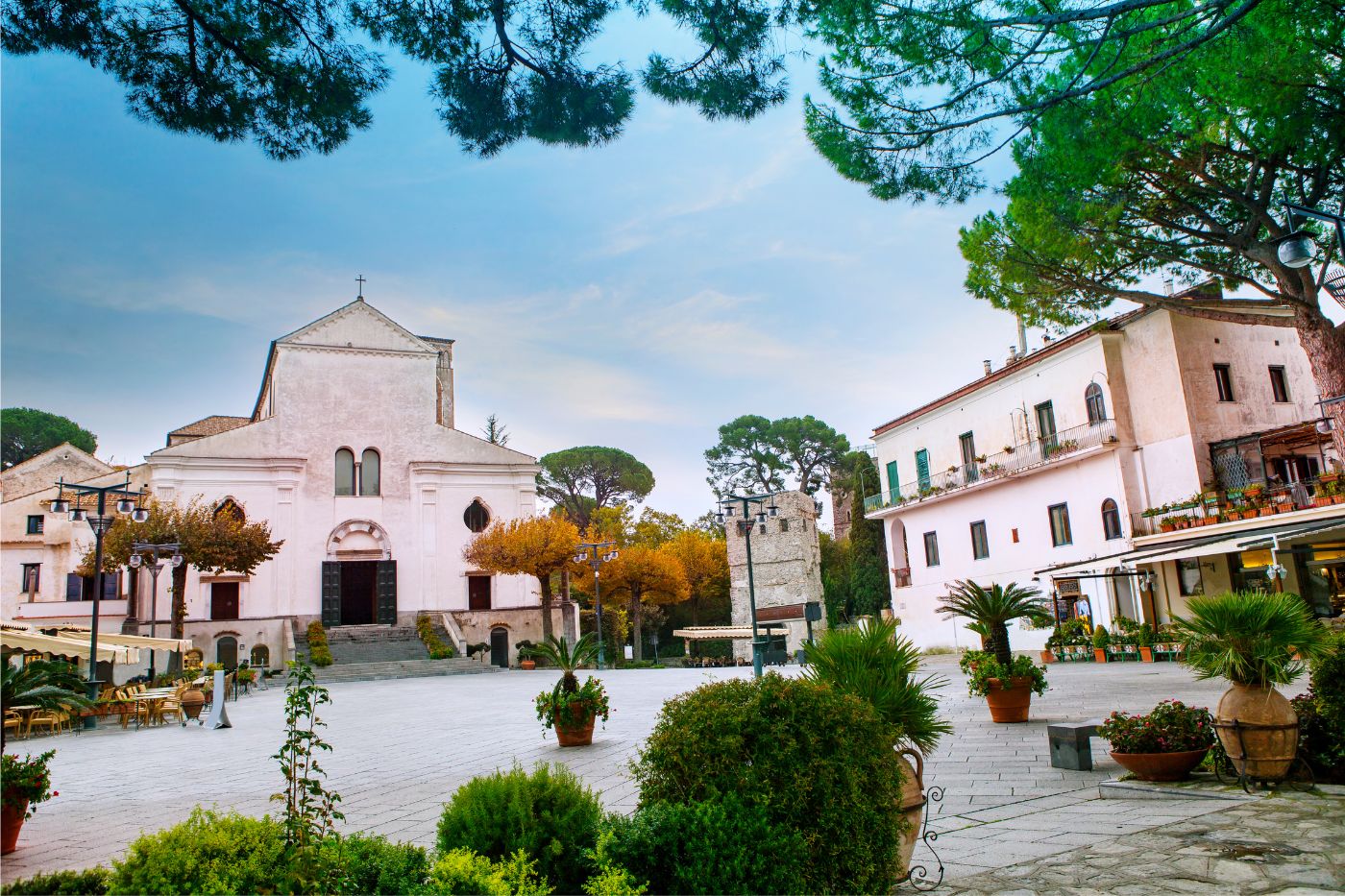
There is a place in the heart of Ravello where spirituality, history and art come together in an atmosphere suspended in time. This is the Cathedral, also known as the Basilica of Saint Mary of the Assumption and Saint Pantaleon, overlooking the picturesque Piazza Vescovado and representing one of the most important and fascinating monuments along the entire Amalfi Coast.
The origins of the Cathedral date back to the 11th century. With the establishment of the Diocese of Ravello in 1086, the construction of a new cathedral was begun at the same time, modelled on the Abbey of Montecassino and commissioned by the first bishop, Orso Papice. The building featured three naves divided by a double colonnade, a transept, an underlying crypt and projecting apses. Over the centuries, the building underwent various interventions and alterations, which partly changed its original appearance. From an architectural standpoint, it therefore reveals numerous phases of construction.
Its simple yet elegant façade, with its almost luminous whiteness, welcomes visitors and invites them to discover the treasures preserved inside. The entrance is preceded by a short flight of steps and features three portals, the central one of which stands out for its bronze decoration. Created in 1179 by Barisano da Trani, the portal consists of 54 panels depicting saints, scenes from the Passion and other decorative elements. It is one of the most interesting examples of medieval art in the cathedral and a detail worth observing carefully before entering.
Once across the threshold, the atmosphere changes. The simplicity of the exterior gives way to an interior rich in artistic treasures, where medieval elements coexist with additions created in later centuries. Among the most remarkable works are the two marble-inlaid ambons: the one known as the Epistle Ambon, commissioned in the first half of the 12th century by the second bishop of the diocese, Costantino Rogadeo, and featuring the biblical episode of the prophet Jonah and the sea monster; and the Gospel Ambon, created in 1272 by the sculptor Nicola di Bartolomeo da Foggia and embellished with splendid mosaics. Fragments of the original frescoes and extraordinary sculptural works can also be found along the walls, telling the long history of the building.
On the left side of the main altar is the Chapel of Saint Pantaleon, which was built during the 17th century as a vow by the town to its patron saint, following the earthquake caused by the eruption of Mount Vesuvius on 16 December 1631. Inside, a 17th-century painting by the Genoese artist Gerolamo Imperiali depicts the martyrdom of the saint, tied to an olive tree with his teacher Ermolao beside him. Beneath the painting, enclosed in a gilded silver reliquary, is the vial containing the blood of Saint Pantaleon, which liquefies every year on 27 July, the day of his martyrdom—an event that attracts pilgrims and visitors from all across the Amalfi Coast.
The Cathedral Museum is housed in the crypt and in a room near the right-hand nave. It contains funerary urns, sarcophagi, sculptures, silver artefacts and stone decorations originating from marble furnishings that no longer exist. Particularly noteworthy are the 13th-century bust of Sigilgaita Rufolo, the remains of the ciborium (four architraves, two capitals, three small columns, the eagle of Saint John and the Agnus Dei), a mosaic pluteus, The Falconer, the reliquary bust of Saint Barbara and an 18th-century pastoral staff decorated with a statuette depicting the martyrdom of Saint Pantaleon.


