The Sentiero delle Formichelle
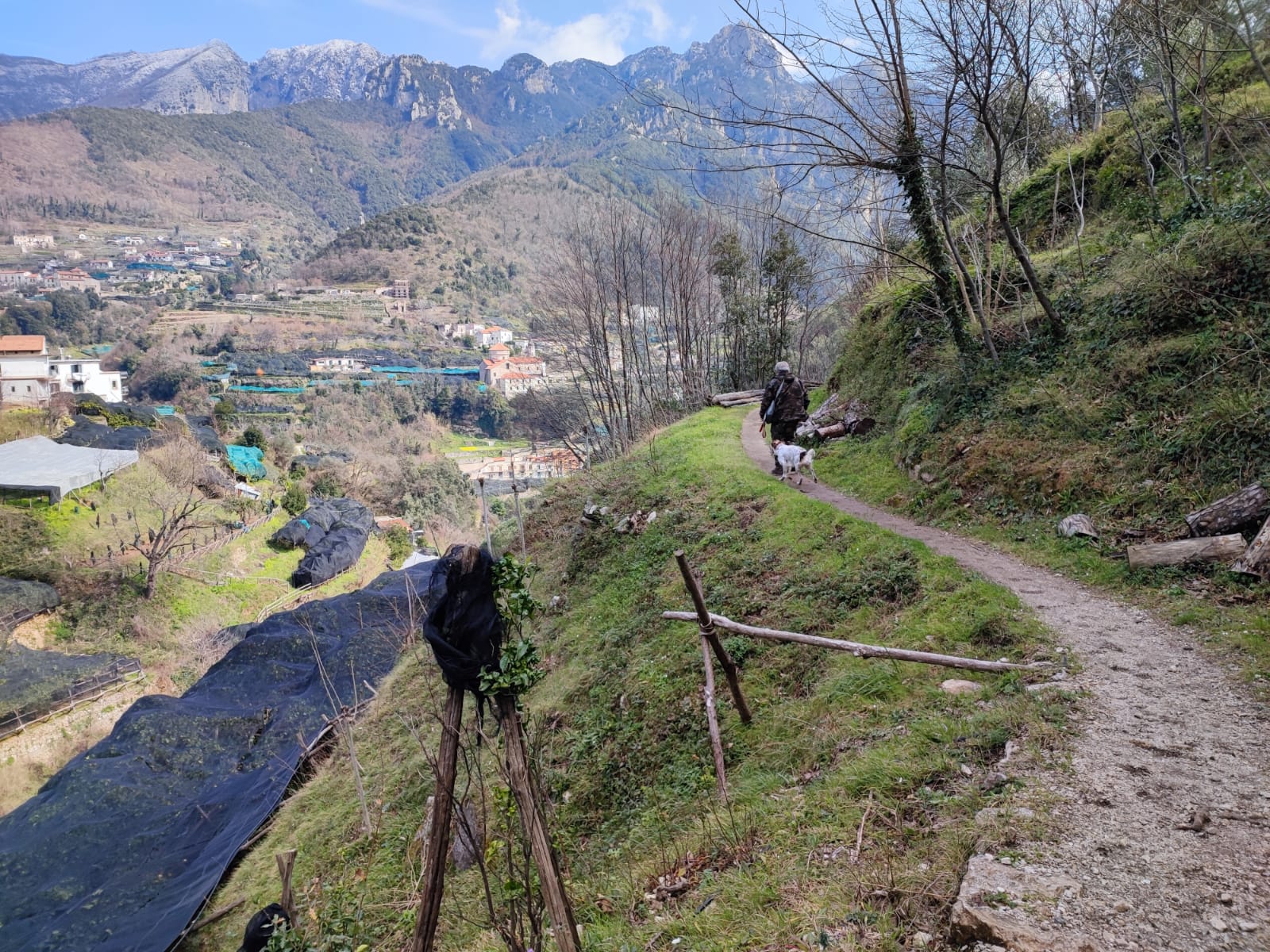
The Amalfi Coast is famous all over the world for its breathtaking views, villages perched on the cliffs and that deep blue sea that seems to accompany you at every step. Yet there is a quieter, more authentic side of the coast, made up of ancient mule tracks and trails, some longer and some shorter, some well-known and others less frequented, which for centuries served as the main routes connecting the small inland villages with the sea.
Among them is one that descends from Tramonti, passing through ancient mills, lemon gardens and unspoilt woods. It is called the Sentiero delle Formichelle and, if you have not discovered it yet, now is the time to do so.
Why is it called that?
The name is not simply a poetic invention, but a true tribute. The formichelle were the women who walked the trails and terraces of the Amalfi Coast with heavy baskets filled with lemons balanced on their heads. They were called formichelle, meaning “little ants“, because they moved in single file, with those descending towards the coast carrying lemons crossing paths with those heading uphill with empty baskets. Their movements resembled a kind of dance along the walkable slopes that connected the villages with the terraces descending towards the sea.
It was incredibly demanding work, carried out with a natural ease and resilience that today leave you as breathless as the view itself. It is no coincidence that this story also inspired a novel, Il Sentiero delle Formichelle by Alessia Castellini, which tells the lives of two pairs of sisters: twins Rachele and Nannina in the 1940s, and their nieces Ninfa and Alelì today, united by family secrets and an unbreakable bond with their homeland.
Walking the Sentiero delle Formichelle today therefore means following in their footsteps and connecting with a memory that is deeply rooted in the Amalfi Coast.
The route
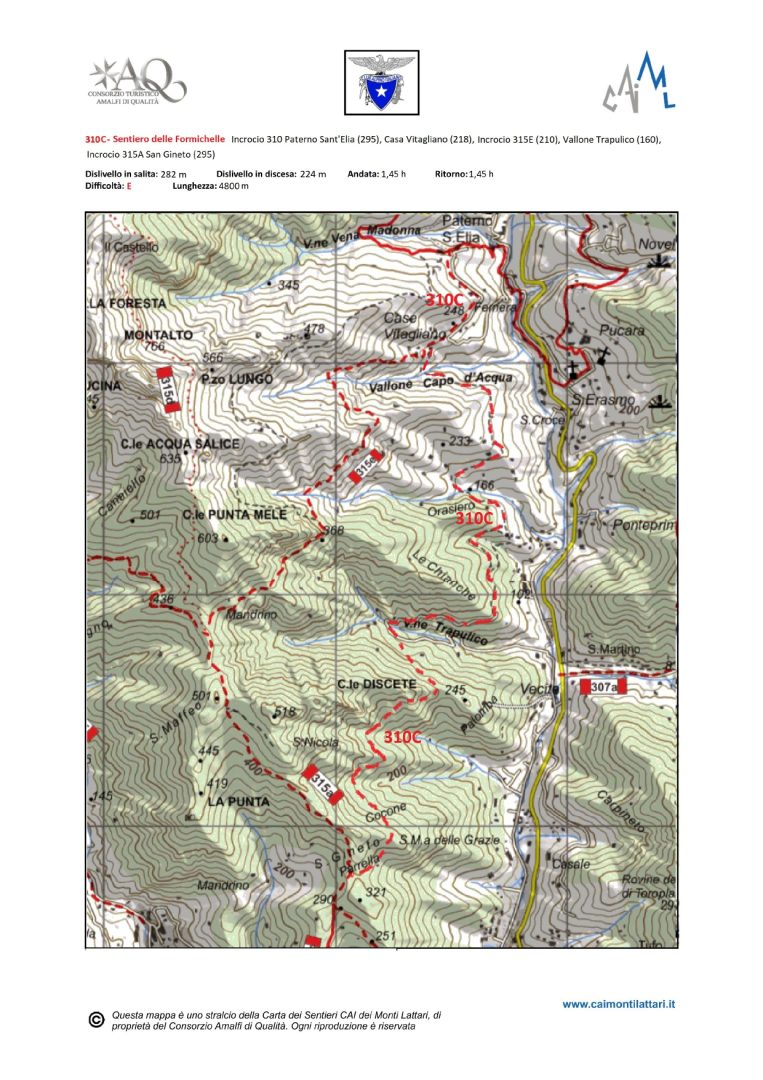
The Sentiero delle Formichelle connects Tramonti with the nearby seaside towns of Maiori and Minori. It is of moderate difficulty and takes approximately 3–4 hours to complete, depending on your pace and the time spent taking breaks.
The route begins in Paterno Sant’Elia, one of the hamlets of Tramonti, near the Church of Sant’Elia, where it intersects with the Sentiero delle 13 Chiese, another well-known trekking route. From this junction, take Via Vitagliano, the paved road on the right-hand side of the church, and continue downhill towards Casa Vitagliano. Here, leave the paved road and take a municipal footpath on the right.
After approximately 200 metres, you reach another junction, where the route intersects with Sentiero 315E, leading towards Ravello. Keep to the left and continue along the trail, which after a short initial section with some steps becomes an unpaved path and remains so for the rest of the route.
Continuing onwards, you reach the Vallone Trapulico, which is easily recognisable thanks to an old water channel carved into the rock, visible on the right-hand side of the trail. From here, the route climbs again, following the steeper section on the right and then the pedestrian path leading to San Gineto, where the Sentiero delle Formichelle ends at the junction with Sentiero 315A.
For more information about the trail, visit the official website of CAI Monti Lattari.
Photo © Authentic Amalfi Coast


