Provolone del Monaco PDO
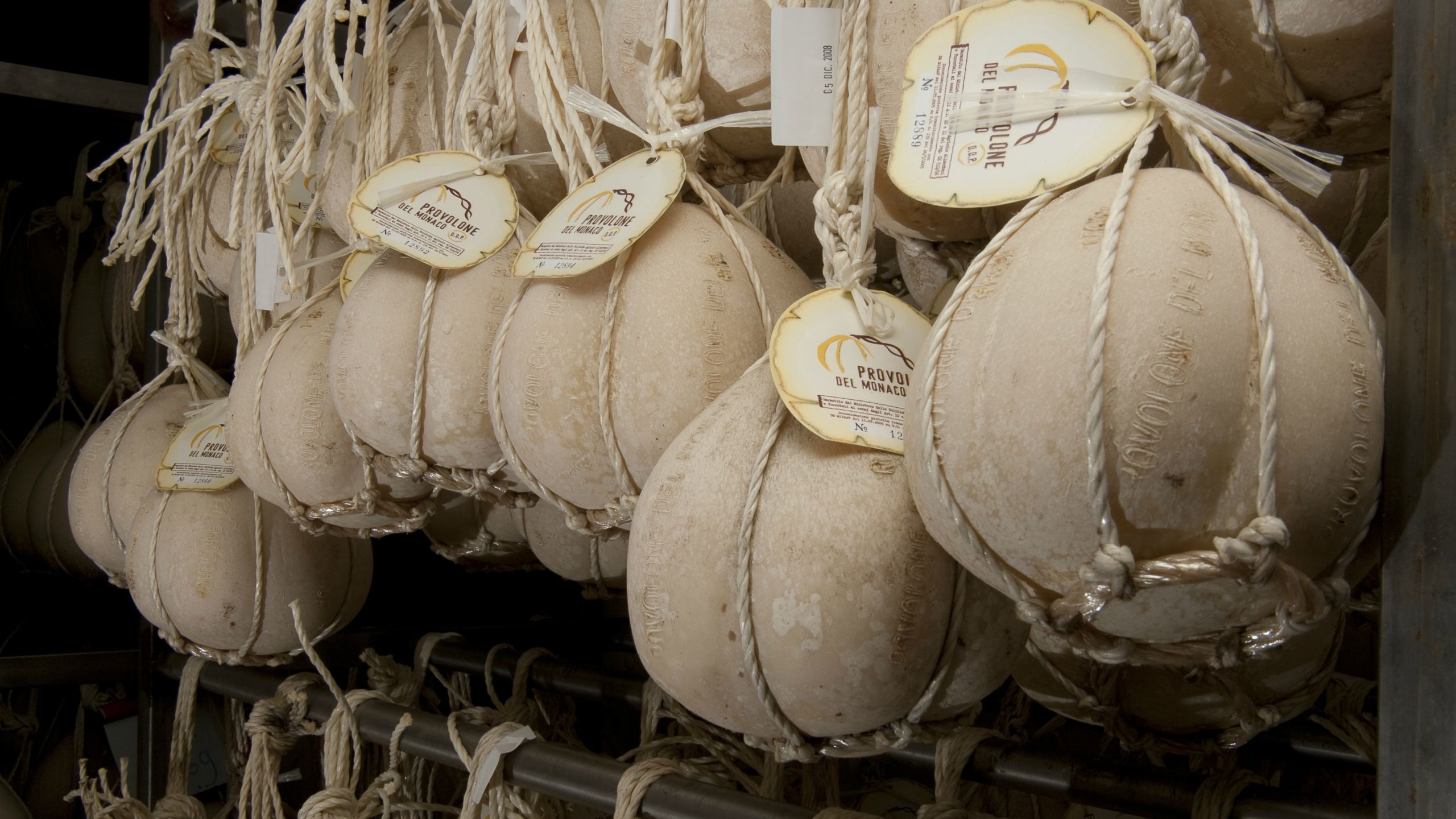
Among the gastronomic treasures carefully preserved by the Amalfi Coast and its surrounding areas, Provolone del Monaco PDO holds a place of honor. It is not just a cheese: it is the result of ancient know-how rooted in the Monti Lattari, with a deep connection to the land and the artisanal techniques that still guarantee its authenticity today. The high quality of the milk produced in the area, particularly suitable for cheesemaking, has encouraged the development of a thriving dairy industry, generally made up of small and medium-sized companies dedicated to the production of this cheese.
As for its name, “provolone” derives from the techniques used to test the curd and from the remarkable stretching properties of the paste, while “del monaco” is closely linked to the way the cheese was transported to the market in Naples. Cheesemakers, carrying their loads of provolone from the various locations of the Monti Lattari, reached the city by sea and, to protect themselves from the cold and humidity, used to cover themselves with a cloak similar to the habit worn by monks. People working at the port began to call these sellers “monaco”, and consequently the cheese they transported became known as “provolone del monaco”.
What exactly is Provolone del Monaco PDO? It is a semi-hard stretched-curd cheese, aged and produced exclusively with raw milk, coming for at least 20% from Agerolese cattle and for the remaining share from different breeds (Friesian, Brown Swiss, Red Pied, Jersey, Podolica) raised in the production area. It has a slightly elongated melon-like shape, with a weight ranging from 2.5 to 8 kg. The rind, thin and yellowish in color, is almost smooth, with slight longitudinal grooves corresponding to the raffia ties used to support the cheeses in pairs. The paste, cream-colored tending to yellow, is compact, elastic, and uniform, without flaking and with typical small holes. The flavor is sweet and buttery, with a slight and pleasant spicy aftertaste.
The production of Provolone del Monaco PDO still follows a traditional method that combines artisanal expertise with respect for local cheesemaking techniques. Milk collected after each milking is coagulated for 40–60 minutes with the addition of kid goat rennet paste or natural liquid calf rennet. The curd is then broken into small grains and subjected to scalding and stretching processes. Once the desired consistency is reached, shaping takes place. The resulting forms are then cooled in cold water, salted in brine, and tied in pairs. Afterwards, they are hung on special structures where they dry for a period ranging from 10 to 20 days. Aging then continues in rooms kept between 8 and 15 °C for at least six months.
Besides being enjoyed on its own as an appetizer or at the end of a meal, it is also widely used in cooking as an ingredient in many preparations, giving dishes an extraordinary flavor. The most renowned recipes include pasta and potatoes, paccheri with eggplant and provolone, provolone ravioli, mussel and provolone risotto, and sliced beef with provolone shavings. Traditionally, it is paired with full-bodied, well-aged red wines.
Photo © Fondazione Qualivita


