The ancient art of bobbin lace on the Amalfi Coast
The Amalfi Coast is a place where beauty can also be found in the smallest details. Not only breathtaking views, villages perched on the cliffs, churches with colourful majolica-tiled domes and terraces overlooking the sea, but also ancient crafts and traditions that still tell the story and identity of the area today.
Among these is the art of bobbin lace, a refined lace-making technique that, thanks to the dedication of generations of women, has been passed down from one generation to the next. It is a craft that requires patience, precision and great manual skill, transforming simple materials into genuine works of art.
What is bobbin lace?
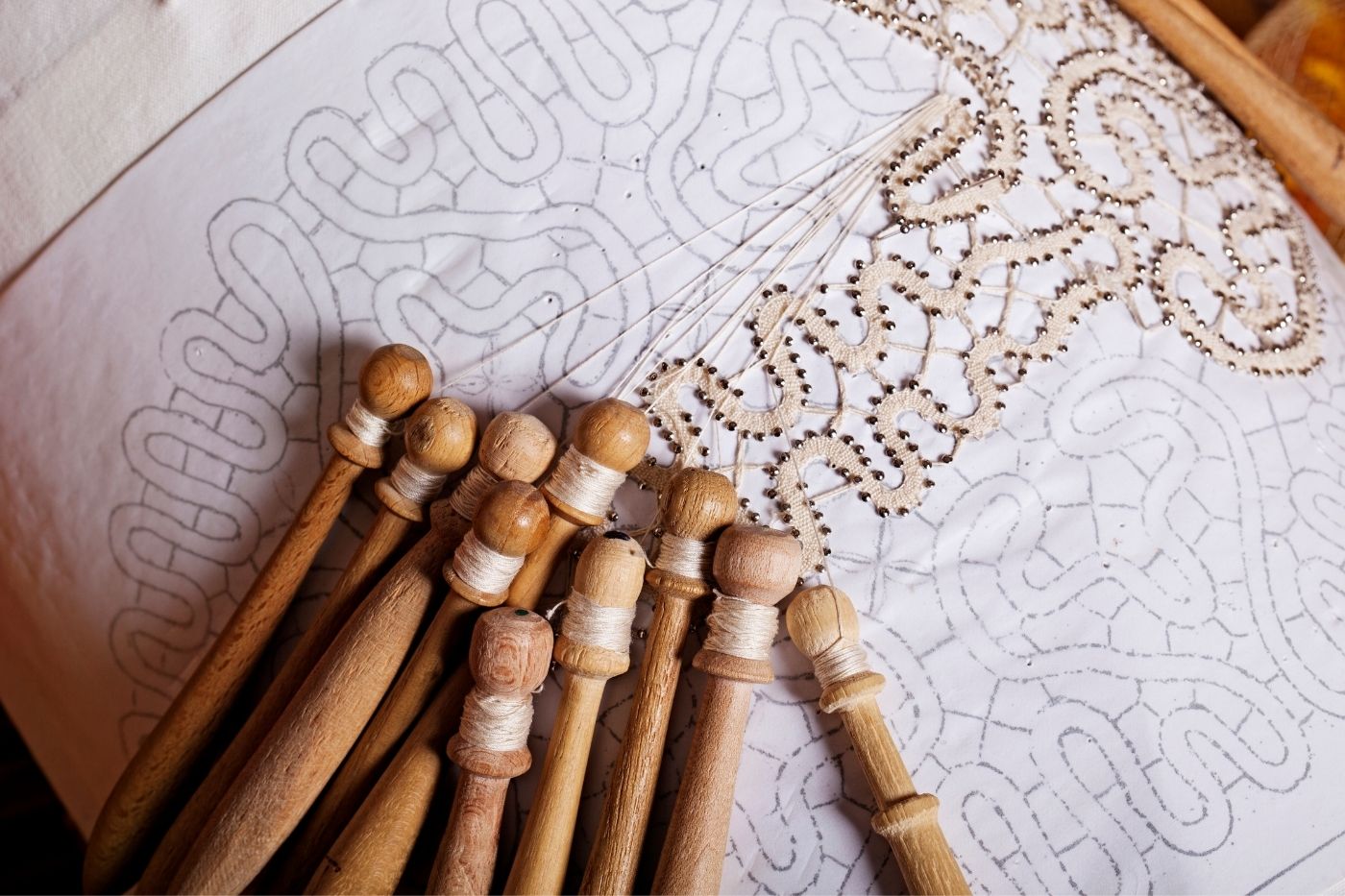
The term bobbin lace refers both to the lace itself and to the tool used to make it: a generally cylindrical cushion onto which the pattern to be reproduced is pinned. The lace is made using pairs of small sticks known as bobbins, around which the thread needed for the work is wound. By crossing and intertwining them according to a precise pattern, skilled lace makers can create increasingly elaborate and delicate designs.
The result is an exceptionally light lace, characterised by ornamental motifs and remarkable precision. The most complex pieces can require around one hundred bobbins and extremely long production times, sometimes taking months or even years, depending on the size and complexity of the work. It is precisely this slowness, so rare today, that makes bobbin lace so precious.
Bobbin lace on the Amalfi Coast
The origins of bobbin lace are uncertain, and its history is intertwined with that of several regions of Italy. Over the centuries, the technique spread and developed distinctive characteristics depending on the area, eventually reaching Campania and some towns along the Amalfi Coast.
In Positano, in particular, this tradition became firmly established during the 20th century. In the middle of the century, the Vincentian Sisters taught lace-making to young girls, helping to preserve a craft that was at risk of disappearing. Over time, this knowledge was passed down from older generations to younger ones, becoming part of the area’s traditional craftsmanship.
The great American writer John Steinbeck also witnessed the work of the young lace makers of Positano during his stay on the Amalfi Coast and was deeply impressed by it. He wrote: “High on the mountain, a convent overlooks the sea; here the nuns teach the little girls the delicate art of lace-making. The girls are paid, and the proceeds from the lace help support the school. The nimble fingers of the little girls working with hundreds of bobbins make one’s head spin, but they raise their heads calmly, laughing and chatting as though they had no awareness whatsoever of their magical fingers. Some of the work is incredibly beautiful. I saw a tablecloth, a spider’s web intricate as a thought. Fifty girls had worked on it for a year.“
Even today, while walking through the narrow streets of the Coast, you can come across shops and artisan workshops where lace pieces are proudly displayed. They are small fragments of a story shaped by skilled hands and family traditions that have endured over time.
An art worth preserving
In a world where production is becoming increasingly fast and standardised, bobbin lace on the Amalfi Coast represents almost a small revolution. Each piece is created slowly, through a sequence of movements that require experience and precision and cannot simply be replaced by a machine.
For this reason, bobbin lace should not be considered merely an artisan product, but a true expression of local culture. It is a form of knowledge that tells the story of the role of women in local communities, everyday life in the past and the relationship between generations. It is no coincidence that the art of bobbin lace has been proposed several times for recognition as UNESCO Intangible Cultural Heritage.
As part of these efforts to protect and promote the tradition, the Comitato Arti, Mestieri e Storia (A.M.S.) of Praiano also organises workshops dedicated to the ancient art of bobbin lace. Held at the Andrea Pane Cultural Centre, these sessions aim to pass on techniques and knowledge that are part of the community’s heritage to younger generations.


