The Regional Park of the Lattari Mountains
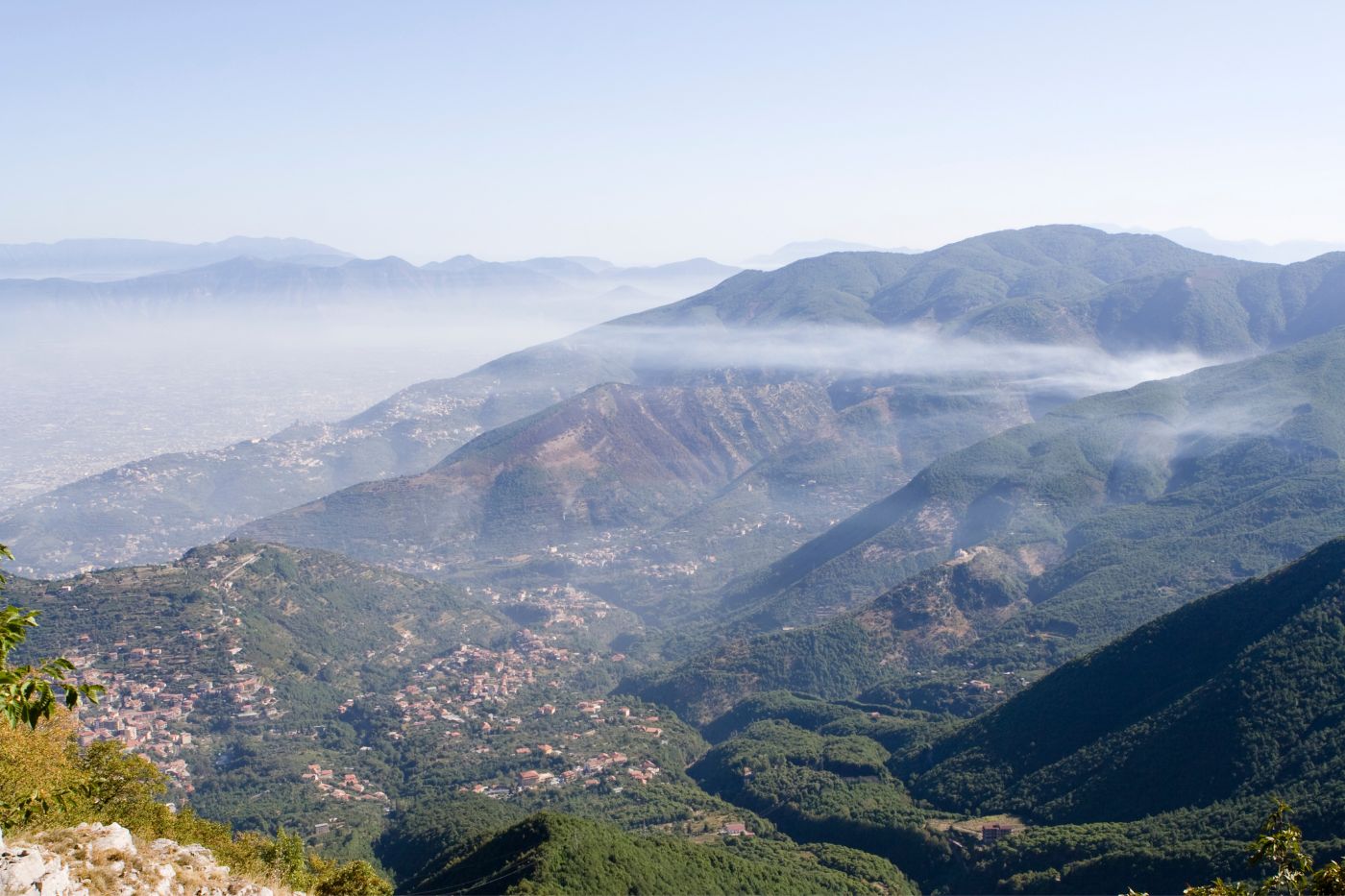
The Regional Park of the Lattari Mountains is one of Campania’s most important natural and scenic treasures, where the mountains plunge dramatically towards the sea, creating a landscape unlike any other in the world. Here, nature intertwines with history, local traditions and a network of trails that allows visitors to discover the area from ever-changing perspectives. For those visiting the Amalfi Coast, exploring this protected area means discovering a wilder landscape rich in different environments, where the scent of Mediterranean scrub meets the sea breeze and the mountains offer spectacular views.
The territory
Established in 2003 to protect and enhance the heritage of the Lattari Mountains, the park covers an area of approximately 16,000 hectares and extends across the entire Sorrento-Amalfi Peninsula. Its highest peaks are Sant’Angelo a Tre Pizzi, Mount Faito, Mount Finestra and Mount Avvocata.
The area is naturally bounded by the Gulf of Salerno, the Agro Nocerino-Sarnese plain and the Gulf of Naples and includes no fewer than 27 municipalities: on the Amalfi Coast, Vietri sul Mare, Cetara, Tramonti, Maiori, Minori, Atrani, Amalfi, Scala, Ravello, Furore, Conca dei Marini, Praiano, Cava de’ Tirreni and Positano; in the Agro Nocerino area, Angri, Nocera Inferiore, Sant’Egidio del Monte Albino, Pagani and Corbara; and on the Sorrento Peninsula, Vico Equense, Meta di Sorrento, Piano di Sorrento, Pimonte, Gragnano, Lettere, Agerola and Castellammare di Stabia.
The Lattari Mountains form the western extension of the Picentini Mountains and consist almost entirely of limestone rocks formed during the Mesozoic Era. Subsequent compression and uplift shaped steep slopes and rocky cliffs, particularly evident on the Amalfi side. The extensive fracturing of the rocks also encouraged karst phenomena and the formation of numerous caves and springs.
The park therefore features a highly varied landscape, with deep valleys, cultivated terraces and mountain ridges offering privileged viewpoints over the coast. It is precisely this constant transition between different environments that characterizes the landscape of the Lattari Mountains and makes it interesting not only from a naturalistic perspective, but also for those who want to learn more about the area’s history and the relationship between people and nature that has developed over the centuries.
Flora and fauna
The climate, morphology, soil variability and exposure create a diverse plant landscape that can be broadly divided into three groups. Near the sea and on the most exposed slopes, carob trees and wild olive trees are particularly common; at higher elevations, holm oak, manna ash, downy oak, strawberry tree and heather prevail, while at greater altitudes chestnut, alder, hornbeam, ash and beech trees can be found. This natural vegetation is complemented by terraces built by people to cultivate citrus groves and vineyards, even on the steepest slopes.
Among the most interesting plant species are Woodwardia radicans, a tree fern dating back to the Cenozoic Era that grows in the Valle delle Ferriere, and Pinguicula hirtiflora, an extremely rare carnivorous plant found in the eastern sector of the park, which feeds on small insects.
The fauna is equally diverse. The park’s different habitats are home to numerous bird species, including buzzards, kestrels, peregrine falcons, yellow-legged gulls, ravens and blue rock thrushes, while mammals include foxes, weasels, stone martens and hedgehogs, although they are not easy to spot.
Experiencing the Park
For lovers of outdoor activities and hiking, the Lattari Mountains are a true paradise. The hiking network includes routes of very different lengths and levels of difficulty, from easy walks to trails intended for experienced hikers. The CAI Monti Lattari hiking association lists more than one hundred routes, providing information on their characteristics, length, elevation gain and difficulty.
Among the most beautiful and accessible routes are the Path of the Gods, the trails around Mount Faito and Mount Molare, and the long walk through the Valle delle Ferriere and the Valle dei Mulini.
Some trails also allow visitors to combine walks in nature with the discovery of historic villages. The paths cross a landscape that has long been inhabited and shaped by people, where ancient mule tracks, stairways, terraces and small settlements tell the story of how local communities learned to live in an environment characterized by steep elevation changes.
And then there are the views. As you climb along the trails, the perspective over the Amalfi Coast constantly changes: Positano, Praiano, Amalfi and the other coastal towns appear from above, while on clear days the view can extend across the Gulf of Salerno as far as Capri and the Gulf of Naples.
The flavors of the Park
The richness of the Lattari Mountains is expressed not only through the landscape, but also through the unique flavors of a centuries-old food and wine tradition. The deep connection between people and the land has given rise to outstanding local products, shaped by high-altitude pastoral farming and the traditional cultivation of crops on steep terraces.
In particular, the area is known for Provolone del Monaco PDO, a semi-hard stretched-curd cheese with a light and pleasantly spicy aftertaste; fiordilatte from Agerola, often confused with mozzarella, from which it differs in the type of milk used, its texture and its low whey release; Amalfi Coast Lemon PGI, also known as Sfusato Amalfitano because of its distinctive elongated shape; and the DOC wines of the Amalfi Coast.


